The best is yet to come
OK
Log out of UNA?
Log out
Cancel
Revolutionizing Immigration with AI
My Appointments
Welcome to UNA
IRCC releases latest processing time update with notable shifts across key immigration categories

IRCC released its newest processing time update on November 12, 2025, showing contrasting trends across immigration categories

The latest processing time update from IRCC includes new data across permanent residence, citizenship, family sponsorship, study permits, work permits, and PR cards. IRCC notes that its updated tool reflects actual processing durations rather than legacy targets, providing applicants with a clearer picture of expected wait times.

1. Citizenship Applications: Longer waits for certificates and renunciation cases

  • Citizenship Grant: 13 months (≈290,700 people waiting), no change
  • Citizenship Certificate: 9 months (+1 month)
  • Renunciation of Citizenship: 22 months (+12 months)
  • IRCC is currently issuing AORs for applications submitted around July 28, 2025

2. Permanent Resident Cards: Minor improvements for renewals

Application TypeProcessing TimeChange Since Oct 29
New PR Card61 days-2 days
PR Card Renewal29 days-1 day

3. Family Sponsorship: Parents and grandparents see major increases

Family sponsorship continues to be one of the longest-processing categories in the entire IRCC system. Quebec applications remain significantly slower due to mandatory provincial approval.

Family Sponsorship Processing Times (as of November 6, 2025)

Sponsorship CategoryPeople WaitingProcessing TimeChange Since October
Spouse/Partner (Outside Canada, non-Quebec)~45,200 (-700)14 months-1 month
Spouse/Partner (Outside Canada, Quebec)~20,100 (-200)37 months-2 months
Spouse/Partner (Inside Canada, non-Quebec)~49,900 (+400)20 months-2 months
Spouse/Partner (Inside Canada, Quebec)~12,200 (+100)37 months-2 months
Parents/Grandparents (non-Quebec)~47,100 (+5,600)42 months+16 months
Parents/Grandparents (Quebec)~12,900 (+1,100)50 months+6 months

The most significant increases were seen in the Parents and Grandparents Program (PGP), with non-Quebec applications rising to 42 months and Quebec applications reaching 50 months.

4. Economic Immigration: Express Entry stable, but business programs remain severely backlogged

Economic immigration streams show a split trend:

  • Express Entry (FSWP, PNP-EE) remains stable
  • CEC increased slightly
  • Business immigration (SUV, Self-Employed) continues to face waits of a decade or more
  • Atlantic Immigration Program (AIP) remains one of the slowest PR pathways

Economic Class Processing Times (as of November 6, 2025)

ProgramPeople WaitingProcessing TimeChange Since October
Canadian Experience Class (CEC)~19,800 (+1,900)7 months+1 month
Federal Skilled Worker Program (FSWP)~24,500 (+700)6 monthsNo change
Federal Skilled Trades Program (FSTP)Not availableNot enough dataNo change
PNP (Express Entry)~10,700 (-800)6 months-1 month
PNP (non-Express Entry)~96,000 (+1,300)16 monthsNo change
Quebec Skilled Worker (QSW)~26,400 (+1,600)11 monthsNo change
Quebec Business Class~4,10084 months (7 years)No change
Federal Self-Employed~8,500 (-100)More than 10 yearsNo change
Atlantic Immigration Program (AIP)~13,300 (+200)37 monthsNo change
Start-Up Visa (SUV)~43,800 (+600)More than 10 yearsNo change

SUV and federal self-employed remain the slowest immigration pathways in Canada’s entire system.

5. Study Permit Processing: Many countries see faster times

CountryProcessing TimeChange Since Oct 29
India4 weeks-1 week
United States4 weeks-1 week
Nigeria8 weeksNo change
Pakistan7 weeks-3 weeks
Philippines4 weeks-1 week

6. Work Permit Processing: Modest improvements in some regions

CountryProcessing TimeChange Since Oct 29
India10 weeksNo change
United States4 weeksNo change
Nigeria9 weeks-1 week
Pakistan6 weeks-2 weeks
Philippines6 weeksNo change

Frequently Asked Questions (FAQ)

1. How often does IRCC update processing times?

  • PR and citizenship categories: monthly
  • Temporary residence (work permits, study permits, visitor visas, PR cards): weekly

2. Are processing times guaranteed?

No. They are estimates only. Actual processing depends on background checks, program demand, document review, and the visa office’s workload.

3. Why is family sponsorship slower in Quebec?

Because Quebec requires an additional provincial approval stage, making the process longer and more complex.


加拿大年底首场快速通道省提名抽选发布,PNP类发出1,123份邀请
Canada conducts first December Express Entry draw, issues 1,123 invitations under PNP category
Immigration, Refugees and Citizenship Canada (IRCC) held its first Express Entry Provincial Nominee Program (PNP) draw of December on December 8, issuing 1,123 Invitations to Apply (ITAs)—one of the largest PNP draws of 2025. Candidates needed a minimum Comprehensive Ranking System (CRS) score of 729 and had to have created an Express Entry profile before March 5 at 5:10 a.m. (UTC). To date, IRCC has issued 95,599 ITAs through Express Entry in 2025, with draws continuing to prioritize PNP candidates, Canadian Experience Class (CEC) applicants, French-language proficiency candidates, and priority occupation categories.
12/09/2025
曼省12月首次移民邀请聚焦本地候选人,184人获省提名申请资格
Manitoba Issues 184 Invitations in First December Draw, Prioritizing Candidates with Local Connections
The Manitoba Provincial Nominee Program (MPNP) held its first draw of December on December 5, 2025, issuing 184 Letters of Advice to Apply (LAAs) — the highest number since October. This draw continued Manitoba’s trend since June of selecting candidates primarily through strategic recruitment initiatives, spanning both the Skilled Worker in Manitoba and Skilled Worker Overseas pathways. Candidates linked to the Temporary Public Policy (TPP) category received the majority of invitations. The province reminds applicants that Manitoba Support Letters for TPP-related open work permit applications must be submitted by December 16, while the federal policy itself expires on December 31.
12/08/2025
安大略省提出全面改革省提名系统,拟分两阶段重塑永久居民提名路径
Ontario Proposes Two-Phase Overhaul of Provincial Nominee Program for Permanent Residence
The Ontario government has unveiled a major two-phase plan to redesign the Ontario Immigrant Nominee Program (OINP) and reshape how the province selects candidates for permanent residence. Phase one proposes consolidating the three existing Employer Job Offer streams into a single integrated framework with two pathways based on occupation level. Phase two would eliminate all remaining existing streams and replace them with three new ones: a Priority Healthcare Stream, an Entrepreneur Stream, and an Exceptional Talent Stream. The government is currently consulting stakeholders and has not yet clarified how in-progress applications will be handled once the reforms take effect.
12/05/2025
2026年加拿大将推出多项新的永久居民通道
Canada to Introduce Multiple New Permanent Residence Pathways in 2026
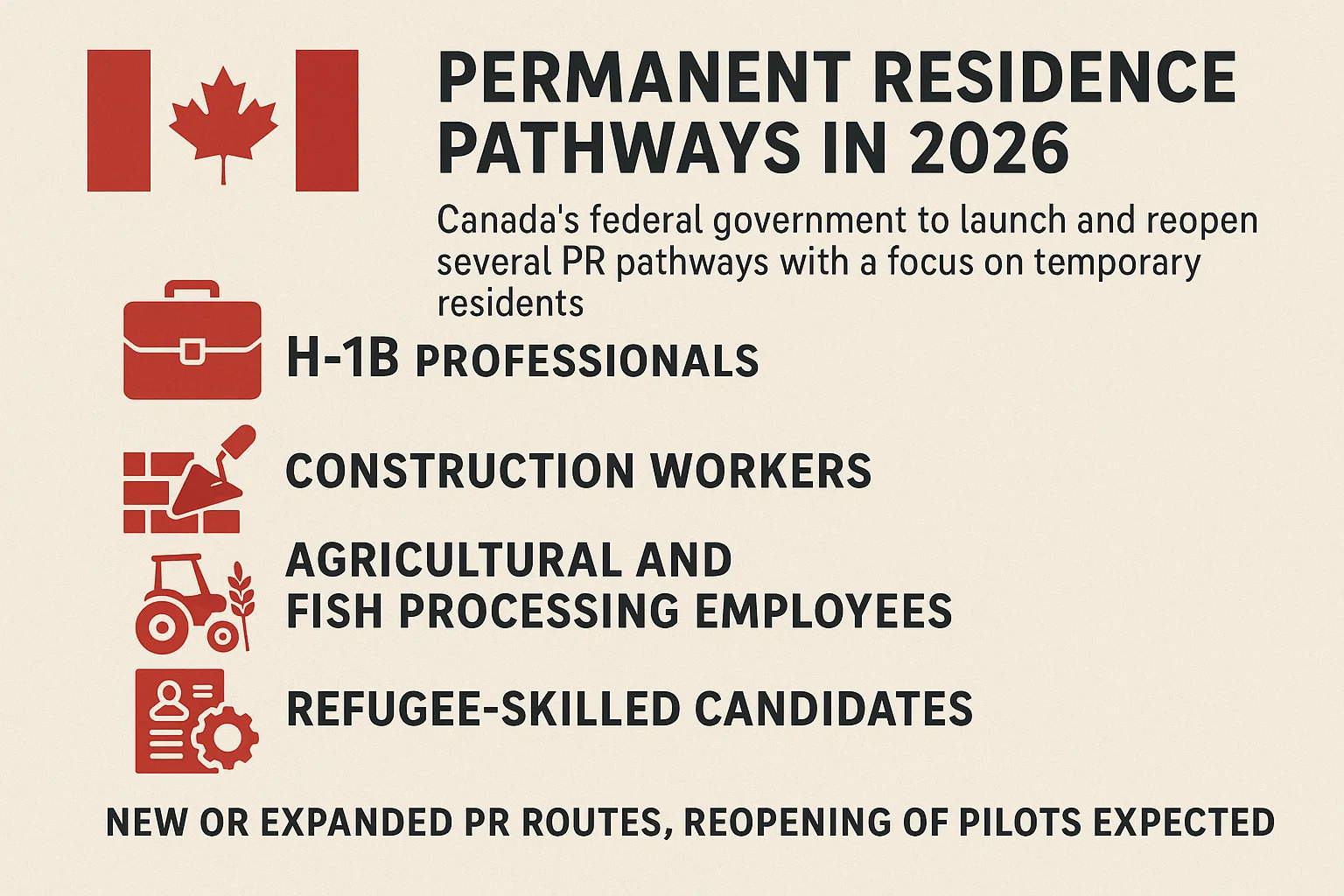
Canada’s federal government is preparing to launch and reopen several permanent residence (PR) pathways in 2026, with a strong focus on transitioning more temporary residents already living in the country. The upcoming year will also see new or expanded PR routes for H-1B professionals, construction workers, agricultural and fish processing employees, and refugee-skilled candidates. Multiple pilots that reached their caps in 2025 are expected to reopen. As many details remain pending, 2026 is shaping up to be a significant year of structural updates to Canada’s immigration system.
12/04/2025
新斯科舍省全面改革省提名与AIP甄选机制,正式引入EOI候选池模式
Nova Scotia Overhauls Provincial Nominee and AIP Selection System with New EOI Model
On November 28, 2025, Nova Scotia announced a major shift in its immigration intake system, confirming that all submissions under the Nova Scotia Provincial Nominee Program (NSPNP) and the Atlantic Immigration Program (AIP) will now be processed through an Expression of Interest (EOI) model. Under the new rules, all submissions—regardless of submission date—are considered EOIs, and having a case ID or meeting eligibility criteria no longer guarantees file processing. The province will conduct periodic draws based on current labor market and economic priorities, with priority sectors such as healthcare, construction, trades, STEM, natural resources, and manufacturing. The shift aligns with broader trends driven by reduced provincial nomination allocations from IRCC. With increased immigration targets set for 2026, applicants may soon see improved chances of receiving selections.
12/03/2025
安省拟开设新技术移民通道,Bill 30赋权省府更灵活管理省提名项目
Ontario plans new skilled immigration pathways as Bill 30 expands provincial authority over OINP
Ontario is preparing to introduce new permanent residence pathways under the Ontario Immigrant Nominee Program (OINP), targeting newcomers in fields such as research, culinary arts, and entrepreneurship. Immigration Minister David Piccini announced on November 25 that the province intends to launch a new “talent stream” to recognize excellence in these sectors. With Bill 30 (the Working for Workers Seven Act, 2025) receiving Royal Assent on November 27, the suspension of the Skilled Trades Stream, and expected increases in provincial nomination allocations for 2026, Ontario is restructuring its immigration program to support more targeted and flexible selection mechanisms.
12/02/2025
加拿大商业投资移民路径概览:创业、企业投资与省提名多渠道并行
Overview of Canada’s Business Immigration Pathways: Federal and Provincial Options for Investors and Entrepreneurs
Canada offers multiple immigration pathways for individuals who wish to immigrate through entrepreneurship or business investment, including the federal Start-Up Visa (SUV), several federal work permit categories, provincial entrepreneur programs, and the Quebec Immigrant Investor Program. Each pathway carries distinct requirements related to investment amounts, business experience, language proficiency, and documentation. With frequent policy changes and complex due-diligence procedures, many applicants work with immigration lawyers or licensed consultants to select the right program, prepare documentation, and maintain compliance to improve approval outcomes and protect their investment.
12/01/2025
加拿大移民局再发6,000份快速通道邀请,法语类别分数降至全年第二低
IRCC issues 6,000 Express Entry invitations with second-lowest CRS cut-off of 2025
On November 28, 2025, Immigration, Refugees and Citizenship Canada (IRCC) conducted another round of Express Entry invitations, issuing 6,000 Invitations to Apply (ITAs) under the French-language proficiency category. This round’s minimum Comprehensive Ranking System (CRS) cut-off was 408 — the second-lowest score recorded in 2025. It marks the eighth French-language draw of the year and the third-largest overall. With this round completed, French-speaking candidates have now received 42,000 ITAs in 2025, continuing to lead all categories. Year-to-date, IRCC has issued a total of 94,476 ITAs through the Express Entry system.
11/29/2025
加拿大经验类移民再迎抽选,CRS分数降至7月以来新低
Canada holds second monthly CEC draw, CRS score drops to lowest level since July
Immigration, Refugees and Citizenship Canada (IRCC) conducted another Express Entry draw on November 26, 2025, inviting 1,000 Canadian Experience Class (CEC) candidates to apply for permanent residence. This round set a minimum Comprehensive Ranking System (CRS) score of 531—the lowest CEC cut-off since July—and ended a five-draw streak where the CRS threshold was locked at 533 or 534. To date, IRCC has issued a total of 88,476 Invitations to Apply (ITAs) through the Express Entry system in 2025.
11/28/2025
加拿大公布2026年留学签证发放目标:总额缩减至40.8万份,较2025年下降7%
Canada Announces 2026 Study Permit Target: Total Allocation Reduced to 408,000, Down 7% from 2025
On November 25, the Government of Canada officially released its 2026 study permit allocation and distribution plan for international students. According to newly published data from Immigration, Refugees and Citizenship Canada (IRCC), the total number of study permits to be issued in 2026 will be capped at 408,000. This continues the federal government’s trend of tightening temporary resident levels, representing a 7% decrease from the 2025 cap of 437,000 and a 16% decrease compared to 485,000 in 2024. The new plan outlines detailed allocation rules by student category, confirms exemptions from Provincial Attestation Letters (PAL) for master’s and PhD students, and distributes PAL-required application volumes and anticipated approvals across provinces based on population share.
11/27/2025
Sorry, your request failed
Please try again
OK