The best is yet to come
OK
Log out of UNA?
Log out
Cancel
Get Personalized Immigration Plans in 5 Minutes
My Appointments
Welcome to UNA
Canada’s Express Entry Latest Data Reveals Immigration Invitation Trends

In the recently concluded month of November, Immigration, Refugees and Citizenship Canada (IRCC) continued its strategy from previous months for Express Entry invitations, placing significant emphasis on Provincial Nominee Programs (PNP), the Canadian Experience Class (CEC), and certain designated categories (particularly candidates in healthcare and those with strong French language abilities). Similar to the levels in October and September, the total number of invitations in November remained around 5,000 to 6,000, aiming to meet the targets of future immigration quota plans.

Breakdown of Categories and Invitation Scales

In November, IRCC held six Express Entry draws, with a predominant allocation of invitations going to PNP, CEC, and specific category candidates (including those in healthcare and strong French language cohorts).

  • Large-scale Healthcare Category Invitations: the most notable event this month was the category-based draw on November 20 targeting healthcare occupations, issuing 3,000 invitations in a single draw—over half of the total invitations for the month.
  • Ongoing Strength in the French Language Category: the French language proficiency draw on November 15 issued 800 invitations, resulting in as many as 69% of November’s invitations going to healthcare and French language category candidates.
  • Modest Distribution for CEC and PNP: compared to the specific categories, CEC (total of 800 invitations in November) and PNP (907 invitations in November) had relatively smaller numbers. Due to the slight reduction in CEC and PNP invitation numbers, the Comprehensive Ranking System (CRS) thresholds for these two categories remained relatively high in November.

Detailed November Invitation Data:

Round #DateRound TypeInvitations IssuedMinimum CRS Score
327November 20, 2024Healthcare occupations3,000463
326November 19, 2024Canadian Experience Class400539
325November 18, 2024Provincial Nominee Program174816
324November 15, 2024French language proficiency800478
323November 13, 2024Canadian Experience Class400547
322November 12, 2024Provincial Nominee Program733812

From this data, it’s clear that IRCC’s overall Express Entry strategy aligns with its latest Immigration Levels Plan, determining invitation directions through an “In-Canada Focus” and “Federal Economic Priorities.” The former includes PNP and CEC, and may also encompass candidates under the Federal Skilled Worker Program (FSWP) and the Federal Skilled Trades Program (FSTP); the latter targets applicants with specific skill sets and strong language abilities.

IRCC had already indicated in an internal memo from July this year that upcoming category-based draws would continue to focus on three main areas:

  1. Candidates with healthcare-related work experience;
  2. Candidates with skilled trades (Trades) experience;
  3. Candidates with strong French language proficiency.

Additionally, a consistent pattern since July shows that PNP rounds typically precede CEC and other category-based draws, a trend that continued in November’s data.

Comparison of Total Invitations Over the Past Three Months

MonthTotal Invitations Issued
November 20245,507
October 20245,961
September 20245,911

This stability in invitation pacing and volume over the past few months has laid a solid foundation for meeting immigration quota objectives over the next two years.

Early December Express Entry Pool Overview

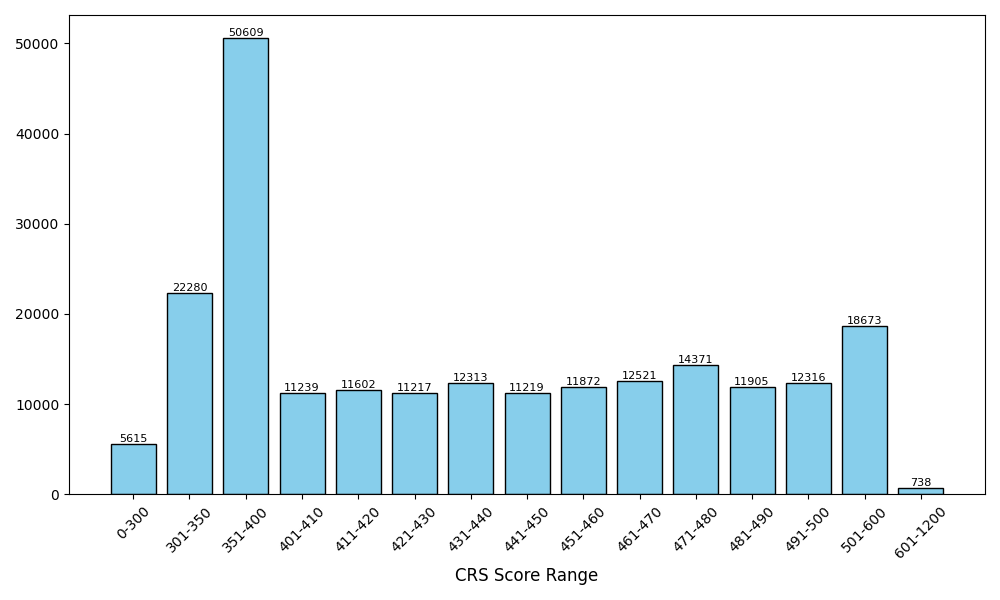
As of December 1, 2024, the latest data shows there are 218,490 candidates in the Express Entry pool. CRS scores are heavily concentrated in the 351-400 range (over 50,000 candidates), with substantial numbers also present across various ranges from 401-500. Candidates scoring above 600 points are relatively few—only about 738.

CRS Score RangeNumber of Candidates
0-3005,615
301-35022,280
351-40050,609 (largest proportion)
401-41011,239
411-42011,602
421-43011,217
431-44012,313
441-45011,219
451-46011,872
461-47012,521
471-48014,371
481-49011,905
491-50012,316
501-60018,673
601-1200738
Total218,490

CRS Score Distribution

From a proportional standpoint, candidates scoring between 501-600 make up roughly 8.55% of the pool, while those above 600 points constitute less than 0.5%. This indicates that candidates receiving PNP bonus points or possessing extremely strong overall profiles remain a minority.

Outlook and Trends

Based on currently disclosed information and recent invitation trends, IRCC is expected to continue the “PNP first, then CEC, followed by category-based draws” sequencing. The focus will remain on healthcare, skilled trades, and candidates with strong French language proficiency. By precisely targeting candidates with certain skills and language backgrounds, Canada aims to ensure that future economic-class immigrants better meet labor market needs and that the overall selection process becomes more refined and strategic.

Overall, November’s Express Entry performance provides a clear signal: IRCC will continue to steadily implement its invitation plan according to established guidelines, balancing various immigration goals while fostering economic growth and cultural diversity in Canada’s future.

Friendly reminder: There are many pathways to immigrate to Canada. We recommend first using UNA AI to generate an objective and neutral immigration plan, so you can gain an initial understanding of the possible immigration pathways and their requirements, and then choose to proceed with one-on-one consultations with a licensed Canadian immigration consultant partnered with UNA.
加拿大留学生规模两年锐减逾二十万,学习许可收紧政策成效显现
International Student Population in Canada Falls by More Than 200,000 Over Two Years as Study Permit Caps Take Effect
Canada's population of international students holding only a study permit has dropped sharply over the past two years, signalling a clear structural shift in federal immigration policy. According to the latest data from Immigration, Refugees and Citizenship Canada (IRCC), the number of study-permit-only holders fell from 673,920 in December 2023 to 460,695 in January 2026, a net reduction of more than 210,000 people, or over 30 percent. The decline became visible from mid-2024, accelerated sharply between March and July 2025, and has remained consistently below 500,000 since late 2025. Analysts broadly attribute the drop to Ottawa's systematic effort to cap international student volumes — a policy first introduced under Justin Trudeau's government in January 2024 and since extended and tightened under Prime Minister Mark Carney, whose 2025 budget slashed the 2026 new study permit allocation from 305,900 to 155,000 (a 49 percent cut), alongside stricter eligibility rules, tougher scrutiny of designated learning institutions (DLIs) and explicit links between intake and housing and labour market capacity. Observers say this is not a short-term correction but a structural turning point that will reshape tuition revenues at Canadian post-secondary institutions, the future pool of permanent resident candidates and housing demand in major cities.
04/17/2026
加拿大快速通道举行年内第四次法语类别抽签 单次发出4,000份邀请
Canada Holds Fourth French-Language Express Entry Draw of 2026, Issuing 4,000 Invitations
On April 15, 2026, Immigration, Refugees and Citizenship Canada (IRCC) held its fourth Express Entry draw of the year targeting candidates with French-language proficiency, issuing 4,000 invitations to apply (ITAs) with a Comprehensive Ranking System (CRS) cut-off of 419 for candidates who had created their Express Entry profiles before 7:14 a.m. UTC on November 14, 2025; this was the second consecutive French-category draw with a reduced invitation count, and the twenty-third overall Express Entry draw of 2026, reinforcing the broader trend of IRCC prioritizing in-Canada candidates—particularly those holding provincial nominations or Canadian work experience—while year-to-date invitations across all categories have now reached 65,154.
04/16/2026
CEC 分数线创年内新高 加拿大发出 2,000 份快速通道邀请
CEC Cut-Off Climbs to New 2026 High as Canada Issues 2,000 Express Entry Invitations
Immigration, Refugees and Citizenship Canada (IRCC) issued 2,000 Invitations to Apply (ITAs) for permanent residence to Canadian Experience Class (CEC) candidates in an Express Entry round held on April 14, 2026, with the Comprehensive Ranking System (CRS) cut-off settling at 515 — six points higher than the previous CEC round on March 31 and the largest single jump in CRS thresholds between draws this year, which also makes it the smallest CEC round of 2026 and underscores IRCC's continued tilt toward in-Canada candidates with domestic work experience or provincial nominations even as the bar to receive an invitation continues to rise; year-to-date, IRCC has issued 61,154 ITAs across all Express Entry categories, with the CEC stream alone accounting for more than half of that total.
04/15/2026
加拿大4月13日快速通道再向省提名候选人发出324份邀请
Canada Issues 324 Invitations to Provincial Nominees in April 13 Express Entry Draw
Immigration, Refugees and Citizenship Canada (IRCC) held another targeted Express Entry draw on April 13, 2026, issuing 324 invitations to apply (ITAs) for permanent residence to candidates in the Provincial Nominee Program (PNP), with a minimum Comprehensive Ranking System (CRS) cut-off of 786 and a profile-creation tie-breaker set at 6:53 p.m. UTC on November 19, 2025; this marks the 21st Express Entry round of 2026 and the eighth PNP-specific draw of the year, reinforcing the program's position as the most frequently used draw category in the current year's invitation calendar; year-to-date, IRCC has now issued 59,154 ITAs across all categories, led by the Canadian Experience Class (CEC) with 30,250 and followed by the French-Language Proficiency stream, confirming Ottawa's continued preference for candidates already working in Canada, holding provincial nominations, or able to serve French-speaking communities.
04/14/2026
加拿大拟全面改革快速通道:合并三大项目,高薪职业将成筛选核心
Canada Proposes Sweeping Express Entry Overhaul: Three Programs to Merge, High-Wage Occupations to Drive Selection
Immigration, Refugees and Citizenship Canada (IRCC) has shared detailed proposals with immigration lawyers to overhaul the Express Entry system, Canada's primary pathway for selecting skilled permanent residents. The proposed reforms would merge the Federal Skilled Worker Program (FSWP), the Canadian Experience Class (CEC), and the Federal Skilled Trades Program (FSTP) into a single immigration stream with unified eligibility requirements — standardizing work experience at one year of cumulative experience within the past three years (Canadian or foreign), setting language proficiency at CLB 6 for all candidates, and eliminating the FSWP's 67-point selection grid. The most consequential change involves a fundamental restructuring of the Comprehensive Ranking System (CRS), introducing a "High Wage Occupation" factor that awards points based on whether a candidate's occupation earns above the national median wage, while proposing to remove or modify points currently awarded for Canadian education credentials, French proficiency, siblings in Canada, and spousal factors. These proposals remain at an early stage, with public consultations planned for Spring 2026 and no implementation timeline announced.
04/11/2026
安大略省四轮定向抽签发出逾1,800份移民邀请,医疗保健类占近九成
Ontario Issues Over 1,800 Immigration Invitations Across Four Targeted Draws, Healthcare Accounting for Nearly 90%
The Ontario Immigrant Nominee Program (OINP) conducted four targeted draws on April 8, 2026, issuing a total of 1,828 invitations to apply (ITAs) across four categories: healthcare and early childhood education, Francophone candidates, the Regional Economic Development through Immigration (REDI) pilot, and physicians. The healthcare and early childhood education draw dominated with 1,635 invitations — nearly 90% of the total — while the Foreign Worker stream minimum score dropped to just 20, down sharply from 36 in the February 2 healthcare draw, signaling Ontario's intensified push to fill critical staffing gaps in these sectors. This marked the province's sixth set of draws in 2026, with all targeted candidates required to hold a valid work or study permit and currently reside in Canada. Notably, these draws come as Ontario prepares for a sweeping overhaul of its immigration system, with legal amendments to the Ontario Immigration Act set to take effect on May 30, 2026, revoking all existing nomination categories — including the Foreign Worker, International Student, and In-Demand Skills streams used in these draws.
04/10/2026
加拿大拟全面重塑快速通道:三大联邦技术移民项目或将被单一新类别取代
Canada Moves to Overhaul Express Entry: Three Federal Skilled Immigration Programs May Be Merged Into a Single New Class
Immigration, Refugees and Citizenship Canada (IRCC) has proposed a sweeping restructuring of its flagship Express Entry system in its newly released Forward Regulatory Plan: 2026–2028, under which the three federal economic immigration programs currently managed through Express Entry — the Federal Skilled Worker Class (FSWC), the Canadian Experience Class (CEC) and the Federal Skilled Trades Class (FSTC) — would be repealed and replaced by a single new class with streamlined eligibility requirements, which IRCC says would help support Canada's economy and businesses by building a more diverse pool of international talent while making the system easier for applicants, employers and partners to navigate; the department has indicated that the reform is still in the proposal phase and plans to consult partners, stakeholders and the public in spring 2026, and if implemented, the change would represent the most significant overhaul of Canada's federal high-skilled immigration framework since Express Entry was launched in 2015.
04/09/2026
阿尔伯塔省AAIP新增135加元意向书提交费用 4月7日起正式生效
Alberta Introduces $135 Fee for Worker Expression of Interest Submissions Under AAIP, Effective April 7
The Alberta Advantage Immigration Program (AAIP) has confirmed that, starting April 7, 2026, foreign nationals submitting a Worker Expression of Interest (WEOI) will be required to pay a new $135 fee, a step that ends the previously free submission process and applies across every worker stream and pathway — including the Alberta Opportunity Stream, the Alberta Express Entry Stream (covering the Accelerated Tech Pathway, the Law Enforcement Pathway and priority sector draws), the Dedicated Health Care Pathways, the Rural Renewal Stream and the Tourism and Hospitality Stream — while remaining entirely separate from the existing $1,500 application fee; the change follows the February 25, 2026 addition of new wage and hours-of-work fields to the WEOI form and comes as more than 44,000 WEOIs sit in the selection pool, with Alberta holding a 2026 allocation of 6,403 nominations from IRCC, of which 1,475 had been issued as of April 1 and 4,928 remain available, with upcoming draws expected to prioritize health care, technology, construction, manufacturing, aviation, agriculture and occupations tied to designated Rural Renewal communities.
04/08/2026
加拿大2026-27年度外国资质认证计划锁定58项协议,惠及逾三万名海外专业人才
Canada Targets 58 Funding Agreements Under Foreign Credential Recognition Program for 2026-27, Aiming to Support Over 32,000 Professionals
Employment and Social Development Canada (ESDC) has set a concrete annual target for its Foreign Credential Recognition (FCR) Program in its 2026-27 Departmental Plan: 58 funding agreements expected to benefit approximately 32,000 internationally trained professionals (ITPs) seeking to work in their fields in Canada. Alongside this target, the federal government has formally committed $97 million CAD over five years, beginning in 2026-27, to establish the FCR Action Fund — a dedicated funding stream designed to work with provinces and territories to improve the fairness, transparency, timeliness, and consistency of credential recognition processes, with a particular focus on the healthcare and construction sectors. These developments signal a shift in Ottawa's approach from project-level funding toward systemic reform of Canada's credential recognition framework.
04/06/2026
加拿大4月起实施八项移民新规:护照涨价、公民权费上调、超级签证门槛放宽
Eight Immigration Changes Take Effect in Canada as of April 1, 2026
Between March 31 and April 1, 2026, the Canadian federal and provincial governments rolled out eight immigration-related changes affecting a wide range of applicants and residents. Canadian passport fees have risen for the first time since 2013, with a 10-year adult passport now costing $163.50, up from $160. At the same time, a new "30 days or free" processing guarantee promises automatic full refunds when applications exceed the 30-business-day window. The right of citizenship fee increased by $3.25 to $123, and permanent residence application fees are set to rise on April 30. The Super Visa program now offers two additional ways for hosts to meet the minimum income threshold, giving more families the chance to bring parents and grandparents to Canada. Provinces and territories have gained greater authority over assessing nominees' intent to reside and economic establishment prospects. Economic-class permanent residents now face a six-year time limit on access to federally funded settlement services, tightening to five years in 2027. Rural employers can hire low-wage temporary foreign workers at up to 15% of their workforce under the TFWP, up from 10%. Saskatchewan has also extended its $500 application fee and $250 second review fee to all SINP worker categories.
04/04/2026
Sorry, your request failed
Please try again
OK