The best is yet to come
OK
Log out of UNA?
Log out
Cancel
Get Personalized Immigration Plans in 5 Minutes
My Appointments
Welcome to UNA
Canada to Introduce Multiple New Permanent Residence Pathways in 2026

New Permanent Residence Pathways Expected in 2026

1. Accelerated Temporary Resident to Permanent Resident (TR→PR) Pathway

Expected launch: 2026 (full details pending)

Under the 2026–2028 Immigration Levels Plan, the federal government aims to transition up to 33,000 temporary work permit holders to permanent residence over 2026 and 2027.

The pathway will focus on individuals who:

  • Are well-established in their local communities
  • Pay taxes and contribute consistently to the Canadian labour market

A similar short-term TR→PR program launched in 2021 reached its cap on the day of opening.

Eligibility criteria and documentation requirements are not yet released.

2. Accelerated PR Pathway for H-1B Visa Holders

Expected launch: Early to mid-2026 (“in the coming months”)

Announced in the 2025 federal budget, this pathway is designed for holders of United States H-1B visas, targeting talent in:

  • Technology
  • Healthcare
  • Research and other high-demand sectors.

Background:

  • Canada’s 2023 open work permit program for H-1B holders reached its 10,000-application cap within days.

Confirmed requirement:

  • Applicants must hold a valid U.S. H-1B visa. Other criteria are still under development.

3. Permanent Residence Pathway for Construction Workers

Announced: March 2025 (details pending)

IRCC plans to admit up to 14,000 foreign construction workers in response to severe labour shortages affecting Canada’s housing supply.

Key elements include:

  • Up to 6,000 spaces reserved for out-of-status construction workers already in Canada

The federal government has not yet clarified whether this will be a PR-only pathway or a combination of temporary and permanent routes.

4. Sector-Specific Stream for Agriculture and Fish Processing

Planned launch: 2025–2026

According to IRCC’s 2025–2026 Departmental Plan, the federal government is developing a new sector-specific pathway in collaboration with Employment and Social Development Canada (ESDC).

The stream will include:

  • Expanded bilateral agreements with partner countries
  • Streamlined hiring for agricultural and fish processing employers
  • A corresponding sector-specific work permit

Eligibility criteria remain undisclosed.

5. New Permanent Pathway to Replace the Economic Mobility Pathways Pilot (EMPP)

Expected launch: 2026 (initially planned for late 2025)

With the EMPP set to expire on December 31, 2025, IRCC is preparing a permanent replacement that will continue supporting:

  • Skilled refugees
  • Displaced professionals
  • Canadian employers seeking access to new labour pools

The latest Immigration Levels Plan also includes a one-time measure to transition about 115,000 protected persons already in Canada to permanent residence, which may be incorporated into the new pathway.

EMPP admission statistics (2019 – March 2025):

  • 970 people admitted

Federal EMPP Job Offer and No Job Offer streams are no longer accepting new applications.

The new pathway is expected to maintain EMPP’s core requirement:

  • Proof of refugee or displaced-person status Additional criteria such as language, education, and work experience may apply.

PR Pilots Expected to Reopen in 2026

1. Home Care Worker Immigration Pilots

Likely reopening in 2026 for in-Canada applicants

Two pilots launched in March 2025:

  • Child Care Home Worker Pilot
  • Home Support Worker Pilot

Each pilot accepted 2,750 applications and hit capacity on the day of opening.

Expected reopening in 2026:

  • In-Canada applicant streams (The outside-Canada streams never opened in 2025 and remain labelled as “Closed.”)

Eligibility requirements:

  • Full-time job offer
  • Language: CLB 4 or higher
  • Education: Secondary school or above
  • Work experience: Minimum six months

2. Rural Community Immigration Pilot (RCIP) & Francophone Community Immigration Pilot (FCIP)

Launched in 2025, these employer-driven pilots help rural communities outside Quebec address labour shortages.

Key features:

  • Mandatory job offer
  • Requirements for education, work experience, language, and settlement funds

Possible updates in 2026:

  • New designated communities
  • Revised priority sectors or occupations

Language requirements:

  • RCIP: CLB 4–6 (depending on NOC)
  • FCIP: French at NCLC 5 in all abilities

Work experience requirement:

  • At least one year (1,560 hours) within the last three years or
  • Graduation from an eligible post-secondary institution in the community

Outlook: 2026 Positioned as a Major Expansion Year for PR Pathways

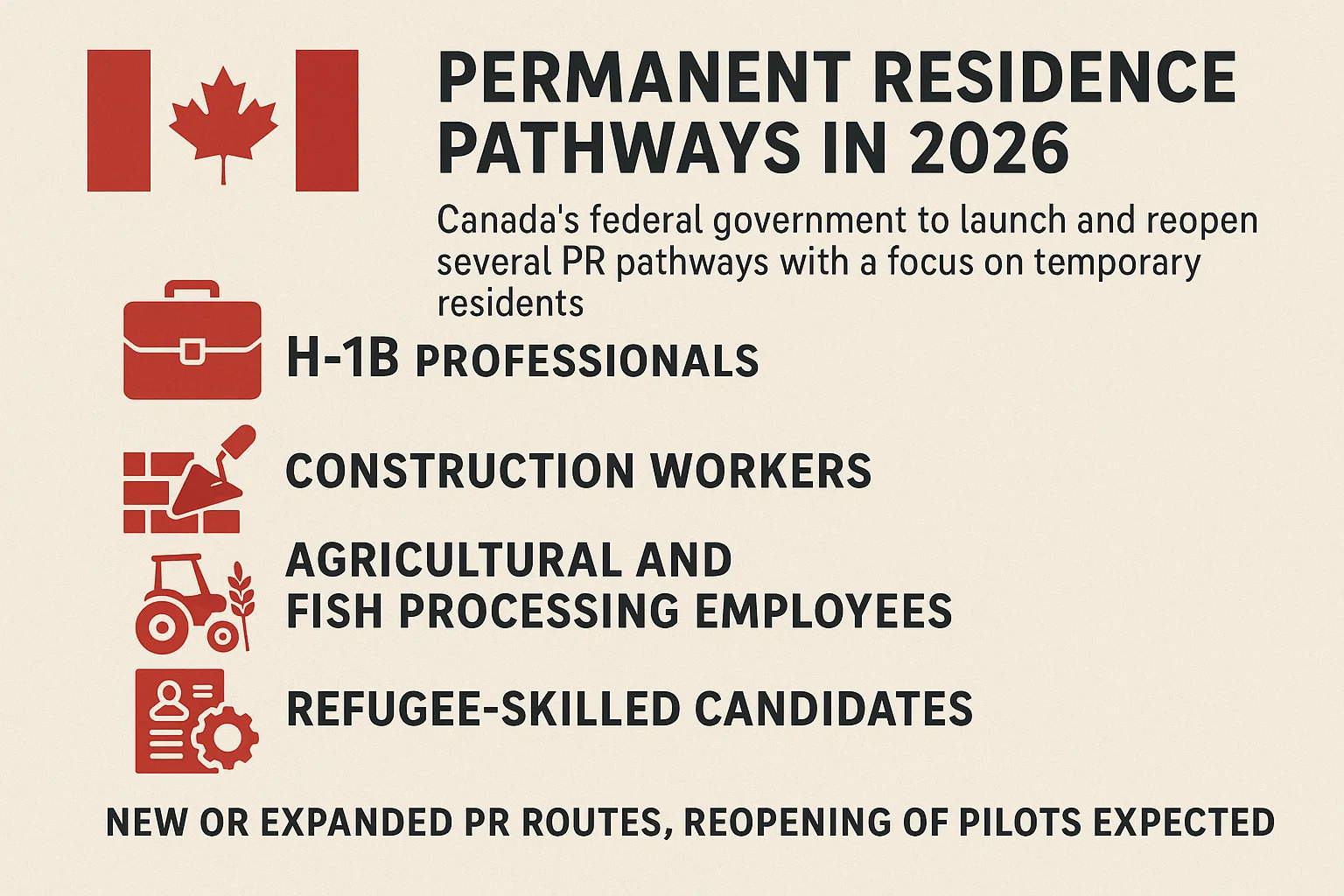
From temporary workers already in Canada to H-1B professionals, construction labour, agricultural and fish processing workers, and refugee-skilled candidates, the federal government is broadening the number and type of candidates who may transition to permanent residence. With several initiatives awaiting final instructions, stakeholders expect more detailed announcements throughout early 2026.

Friendly reminder: There are many pathways to immigrate to Canada. We recommend first using UNA AI to generate an objective and neutral immigration plan, so you can gain an initial understanding of the possible immigration pathways and their requirements, and then choose to proceed with one-on-one consultations with a licensed Canadian immigration consultant partnered with UNA.
加拿大新版 TR 转 PR 通道将排除全部都会区,三大城市临时工无缘申请
Canada's New TR-to-PR Pathway Shuts Out Every Major Urban Centre as Minister Confirms Full CMA Exclusion
Canada's Immigration Minister Lena Diab has confirmed that the federal government's new Temporary Resident to Permanent Resident (TR to PR) Pathway will exclude every one of Canada's 41 Census Metropolitan Areas (CMAs), meaning temporary foreign workers currently employed in Toronto, Vancouver, Montreal, Calgary, Ottawa and other major urban centres will be shut out of the one-time program that is set to grant permanent residence to 33,000 rural and small-community workers over 2026 and 2027; speaking on the April 18, 2026 edition of the immigration show "I'm Canada," Diab said the full selection criteria — including work-experience duration and occupational scope — will be released "in the coming weeks," though she indicated applicants may need close to two years of Canadian work experience and that the pathway is unlikely to be sector-restricted; the CMA carve-out aligns with a broader federal push toward rural immigration, including temporary Temporary Foreign Worker Program (TFWP) flexibilities that took effect April 1, 2026 for rural employers outside CMAs and that have so far been adopted by Nova Scotia, Quebec, and Manitoba, together pointing to a coordinated policy shift that concentrates permanent-residence pipelines in smaller communities while tightening them in Canada's largest cities.
04/24/2026
安省OINP再向逾900名硕士博士毕业生发出提名邀请
Ontario OINP issues 918 nominations to Master's and PhD graduates in second 2026 draw
The Ontario Immigrant Nominee Program (OINP) held its second draw of 2026 targeting international student graduates on April 22, issuing a total of 918 invitations to apply (ITAs) to candidates who completed a master's or doctoral degree at an Ontario university — 674 under the Master's Graduate Stream at a minimum score of 61, and 244 under the PhD Graduate Stream at a minimum score of 56. Compared with the program's March 18 draw, cut-off scores climbed sharply in both streams (up 31 points for master's and 7 points for PhD), a jump industry observers attribute not to a policy tightening but to a surge of high-scoring candidates entering the pool after the previous round. The April 22 draw was also notably broader in scope: unlike the NOC-targeted March 18 round, it imposed no specific National Occupational Classification experience requirement. All of this is unfolding against the backdrop of the deepest restructuring of the OINP in over a decade — the nine existing application categories are scheduled to be formally revoked on May 30, 2026, and replaced by four consolidated pathways (Employer: Job Offer, Priority Healthcare, Entrepreneur, and Exceptional Talent), giving eligible graduates a narrow closing window in which to act on an ITA.
04/23/2026
萨省SINP一季度用掉近四分之一配额 优先行业领跑 受限行业窗口制常态化
Saskatchewan Burns Through a Quarter of Its 2026 PNP Allocation in Q1, With Priority Sectors Leading the Pack
The Government of Saskatchewan has released first-quarter data for the Saskatchewan Immigrant Nominee Program (SINP), showing that as of April 21, 2026, the province has issued 1,223 nominations — roughly 26 percent of its 4,761-nomination annual allocation — leaving 3,538 spots to be distributed over the remainder of the year; against the backdrop of Ottawa's sweeping 50 percent cut to all Provincial Nominee Programs (PNPs) in 2025, Saskatchewan's 2026 allocation sits at only about 60 percent of the roughly 8,000 nominations the province received in 2024, prompting a structural overhaul that slices the annual quota into "priority sectors," "capped sectors" and "other sectors," with capped trades such as accommodation and food services, retail and trucking now managed through a fixed-window intake schedule; Q1 figures show the seven priority sectors — healthcare, agriculture, skilled trades, mining, manufacturing, energy and technology — moving fastest, using up 29 percent of their internal allocation and accounting for more than half of all nominations issued so far, while the capped retail, trade and other services sector leads usage in its category at 31 percent, followed by accommodation and food services at 26 percent and trucking at 19 percent, with non-priority, non-capped "other sectors" sitting at 19 percent overall; the next capped-sector intake window opens on May 4, 2026, on a first-come, first-served basis.
04/22/2026
BC省4月企业家移民抽选发出14份邀请,最低分数降至115分
BC Issues 14 Invitations in April Entrepreneur Draw as Base Stream Cut-Off Slips to 115
British Columbia held its latest Entrepreneur Immigration (EI) selection round on April 14, 2026, issuing 14 Invitations to Apply (ITAs) through the Base stream of the BC Provincial Nominee Program (BC PNP) with a minimum qualifying score of 115 — two points lower than the March 10, 2026 Base-stream draw and the largest standalone EI round the province has run so far this year. With six entrepreneur draws and at least 41 ITAs now issued in 2026 under a federal 2026 allocation of 5,254 nomination spaces (up roughly 31% from BC's initial 4,000-spot allotment in 2025 but still below what the province requested), BC PNP continues to focus on business candidates expected to generate high economic impact in the province.
04/21/2026
安省OINP单周发出逾1,300份邀请函 紧缺技能类别连抽两轮
Ontario Issues Over 1,300 OINP Invitations in Back-to-Back In-Demand Skills Draws
On April 15, 2026, the Ontario Immigrant Nominee Program (OINP) held two back-to-back draws under its Employer Job Offer: In-Demand Skills stream, issuing a combined 1,334 invitations to apply (ITAs) to candidates with qualifying job offers in either agriculture-related occupations or other priority occupations, of which 315 invitations (minimum score 35) went to agriculture candidates and 1,024 (minimum score 36) went to non-agriculture priority occupation candidates — approximately 77% of the total; the two draws together targeted 39 National Occupational Classification (NOC) codes and required candidates to be residing in Canada with a valid work or study permit at the time of selection, with eligible profiles having been created and attested to no earlier than July 2, 2025 and no later than 11:59 p.m. on April 13, 2026, marking OINP's third round of selections in April; notably, OINP is expected to undergo a major program overhaul on May 30, 2026 that will revoke existing applicant categories and consolidate the three current Employer Job Offer streams into a single unified stream, though the province has yet to clarify how existing candidates will be transitioned.
04/20/2026
爱德华王子岛举行2026年最大规模省提名抽签,127名紧缺行业人才获邀
Prince Edward Island Issues 127 Invitations in Largest PNP Draw of 2026
Prince Edward Island's Office of Immigration held its fourth provincial nominee draw of 2026 on April 16, issuing 127 invitations — the largest single round of the year so far. The draw was conducted through the Labour Impact and PEI Express Entry pathways, the only two streams the province has used this year, and focused on candidates currently working in Prince Edward Island (PEI) in priority occupations and sectors deemed to have high economic impact. International graduates from three local post-secondary institutions — the University of Prince Edward Island (UPEI), Holland College and Collège de l'Île — were given further priority. With this round, PEI has now issued a total of 363 invitations under the Prince Edward Island Provincial Nominee Program (PEI PNP) in 2026. The draw took place on the exact date listed in the province's publicly released invitation schedule. Candidates who receive an invitation now have 30 calendar days — down from the previous 60-day window — to file a complete application for provincial nomination.
04/19/2026
加拿大留学生规模两年锐减逾二十万,学习许可收紧政策成效显现
International Student Population in Canada Falls by More Than 200,000 Over Two Years as Study Permit Caps Take Effect
Canada's population of international students holding only a study permit has dropped sharply over the past two years, signalling a clear structural shift in federal immigration policy. According to the latest data from Immigration, Refugees and Citizenship Canada (IRCC), the number of study-permit-only holders fell from 673,920 in December 2023 to 460,695 in January 2026, a net reduction of more than 210,000 people, or over 30 percent. The decline became visible from mid-2024, accelerated sharply between March and July 2025, and has remained consistently below 500,000 since late 2025. Analysts broadly attribute the drop to Ottawa's systematic effort to cap international student volumes — a policy first introduced under Justin Trudeau's government in January 2024 and since extended and tightened under Prime Minister Mark Carney, whose 2025 budget slashed the 2026 new study permit allocation from 305,900 to 155,000 (a 49 percent cut), alongside stricter eligibility rules, tougher scrutiny of designated learning institutions (DLIs) and explicit links between intake and housing and labour market capacity. Observers say this is not a short-term correction but a structural turning point that will reshape tuition revenues at Canadian post-secondary institutions, the future pool of permanent resident candidates and housing demand in major cities.
04/17/2026
加拿大快速通道举行年内第四次法语类别抽签 单次发出4,000份邀请
Canada Holds Fourth French-Language Express Entry Draw of 2026, Issuing 4,000 Invitations
On April 15, 2026, Immigration, Refugees and Citizenship Canada (IRCC) held its fourth Express Entry draw of the year targeting candidates with French-language proficiency, issuing 4,000 invitations to apply (ITAs) with a Comprehensive Ranking System (CRS) cut-off of 419 for candidates who had created their Express Entry profiles before 7:14 a.m. UTC on November 14, 2025; this was the second consecutive French-category draw with a reduced invitation count, and the twenty-third overall Express Entry draw of 2026, reinforcing the broader trend of IRCC prioritizing in-Canada candidates—particularly those holding provincial nominations or Canadian work experience—while year-to-date invitations across all categories have now reached 65,154.
04/16/2026
CEC 分数线创年内新高 加拿大发出 2,000 份快速通道邀请
CEC Cut-Off Climbs to New 2026 High as Canada Issues 2,000 Express Entry Invitations
Immigration, Refugees and Citizenship Canada (IRCC) issued 2,000 Invitations to Apply (ITAs) for permanent residence to Canadian Experience Class (CEC) candidates in an Express Entry round held on April 14, 2026, with the Comprehensive Ranking System (CRS) cut-off settling at 515 — six points higher than the previous CEC round on March 31 and the largest single jump in CRS thresholds between draws this year, which also makes it the smallest CEC round of 2026 and underscores IRCC's continued tilt toward in-Canada candidates with domestic work experience or provincial nominations even as the bar to receive an invitation continues to rise; year-to-date, IRCC has issued 61,154 ITAs across all Express Entry categories, with the CEC stream alone accounting for more than half of that total.
04/15/2026
加拿大4月13日快速通道再向省提名候选人发出324份邀请
Canada Issues 324 Invitations to Provincial Nominees in April 13 Express Entry Draw
Immigration, Refugees and Citizenship Canada (IRCC) held another targeted Express Entry draw on April 13, 2026, issuing 324 invitations to apply (ITAs) for permanent residence to candidates in the Provincial Nominee Program (PNP), with a minimum Comprehensive Ranking System (CRS) cut-off of 786 and a profile-creation tie-breaker set at 6:53 p.m. UTC on November 19, 2025; this marks the 21st Express Entry round of 2026 and the eighth PNP-specific draw of the year, reinforcing the program's position as the most frequently used draw category in the current year's invitation calendar; year-to-date, IRCC has now issued 59,154 ITAs across all categories, led by the Canadian Experience Class (CEC) with 30,250 and followed by the French-Language Proficiency stream, confirming Ottawa's continued preference for candidates already working in Canada, holding provincial nominations, or able to serve French-speaking communities.
04/14/2026
Sorry, your request failed
Please try again
OK